

Subscribe to Our Updates
Join our community and be the first to receive exclusive insights
You are subscribed now!


.svg)

Products
Solutions
Resources
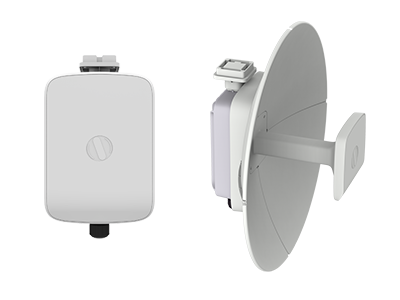
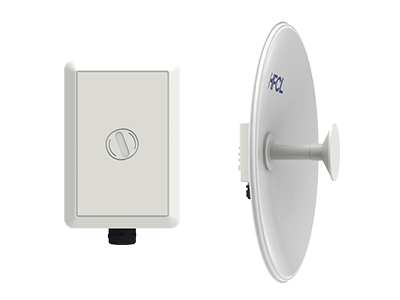
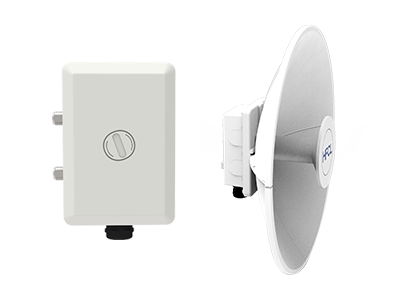
Point-to-point (PTP) Unlicensed Band Radios (UBR) deliver high-capacity wireless backhaul between two locations for service providers, enterprises and public networks. Each PTP radio link delivers fiber-like performance over long distances in unlicensed 5 GHz spectrum, making it ideal where fiber is unavailable, expensive, or slow to deploy.
Available in 700 Mbps to 2 Gbps models, PTP radios support 4G/5G backhaul, enterprise wireless backhaul between sites, and rapid-deployment networks. With 2x2 MIMO, up to 1024 QAM and IP67 housings, the portfolio delivers scalable fixed wireless backhaul for diverse deployment needs.

Extends and augments fiber networks with high-capacity, low-latency wireless links, ideal for bridging gaps, redundancy, and rapid network expansion.
Designed for stable, point-to-point links across long distances with strong interference resilience, ensuring consistent performance for mission-critical backhaul.
Quick rollouts and flexible scaling alongside fiber infrastructure, reducing deployment time and overall cost while maintaining network reliability.


High-Speed Wi-Fi bridges the digital divide. PM-WANI delivers internet access to Baslambi and Baidebettu
Multi-band radio solution, combining UBR radios and IP/MPLS routers for 5G Readiness
Best Practices for Unlicensed Band Radio (UBR) Installation
Reduce RF interference and maximize wireless backhaul performance
Efficient UBR Backhaul for Mobile Operators: High-performance UBR technology addressing last-mile challenges
Enable high-capacity, low-latency backhaul for mobile and broadband networks with reliable PtP links built for long-distance performance.
When selecting PtP radios, think in terms of distance, throughput, and reliability. Long-haul backhaul needs extended 5 GHz or unlicensed band PtPs, while high-capacity enterprise links may rely on short-range, high-throughput radios. PtP radios serve as the “wireless fiber” between two points, so evaluate based on required throughput (Mbps/Gbps), distance (urban vs rural spans), and environmental conditions.
Short-range PtP radios are ideal for connecting sites within a city or campus. PtP wireless radios deliver stable multi-gig performance with low latency, making them suitable for corporate branches, education campuses, and video surveillance backhaul.
Long-range PtP radios provide extended reach over tens of kilometers with strong interference resilience. PtP backhaul radios are built for telecom operators, ISPs, and government agencies needing reliable, high-capacity backhaul for 4G/5G or mission-critical networks.
Essential details about secure, long-distance point-to-point wireless connectivity
The range of a PtP (Point-to-Point) wireless link depends on factors like frequency band, antenna type, transmit power, line-of-sight conditions, and environmental interference. Proper planning, including path profiling and Fresnel zone clearance, ensures maximum throughput and link reliability over extended distances.
Yes. Point-to-Point (PtP) radios are a proven solution for 4G/5G backhaul, ISP networks, and enterprise campuses where fiber is unavailable or expensive. With high throughput, low latency, and carrier-grade performance, they provide reliable, fiber-like connectivity over short, medium, and long distances. Many mobile operators and enterprises use PtP radios to extend networks quickly without compromising on quality.
The performance of PtP radios depends on key factors such as:
With the right model and deployment, PtP radios can maintain consistent performance across varied terrains.
PtP radios are the best choice when:
They offer faster time-to-market and lower TCO (Total Cost of Ownership) compared to fiber in many scenarios.
PtP radios are built with enterprise-grade security protocols, including AES encryption, Management VLAN support, and authentication mechanisms. This ensures that data transmitted between two locations remains protected against interception or breaches. For government, defense, financial institutions, and enterprises, PtP radios deliver both high-capacity and secure connectivity without compromising compliance standards.