



In wireless communication, Multi-User, Multiple Input, Multiple Output (MU-MIMO) stands as a game-changing technology. The emergence of MU-MIMO technology has changed how Wi-Fi routers and devices manage data transmission by enabling Access Points to efficiently serve multiple client devices simultaneously. This breakthrough technology enhances network capacity and alleviates congestion caused by slower devices, delivering a more seamless and equitable wireless experience for users across various devices and speeds. As Wi-Fi standards progressed from 802.11ac to 802.11ax, MU-MIMO emerged as a key player, enhancing efficiency and speed in both uplink and downlink scenarios. With the evolution of Wi-Fi 6 and 6E networks, MU-MIMO has evolved, too, accommodating more streams and bidirectional functionality.
What is MU-MIMO?
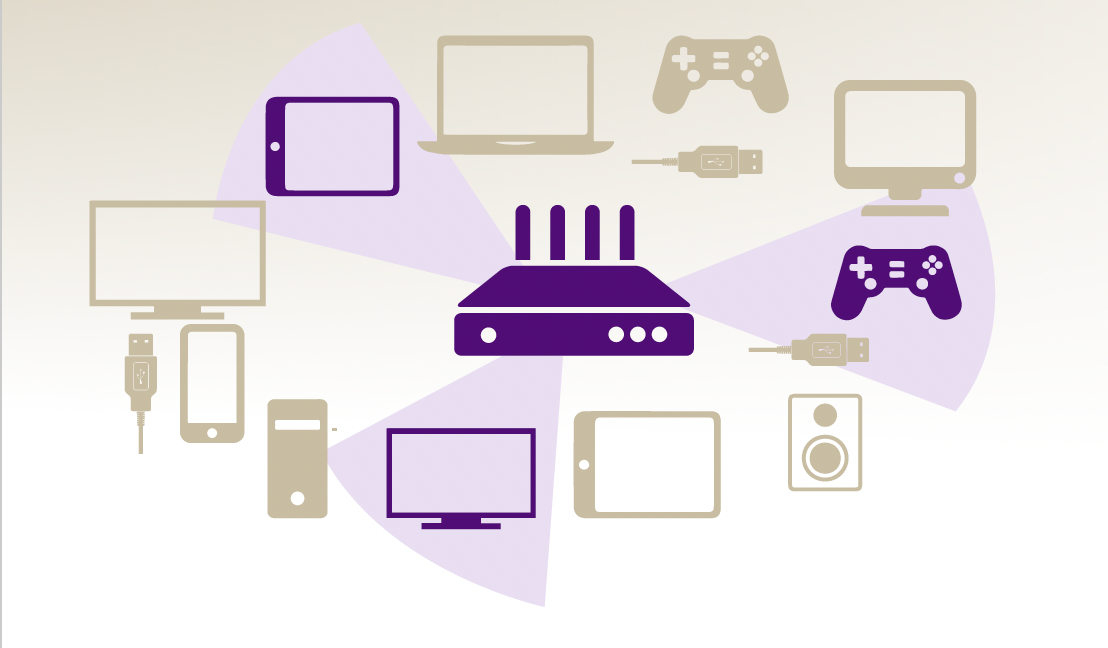
MU-MIMO is an acronym for multi-user, multiple input, and multiple output. It represents a significant advancement over Single-User MIMO (SU-MIMO). MU-MIMO technology enables one Access Point to communicate with multiple devices simultaneously. It reduces the wait time of each device for a signal in the wireless network, thereby significantly enhancing speed.
MU-MIMO technology has become a major part of Wi-Fi 6 (802.11ax) protocol. However, standards older than 802.11ac do not support this technology.
How Does MU-MIMO Work?
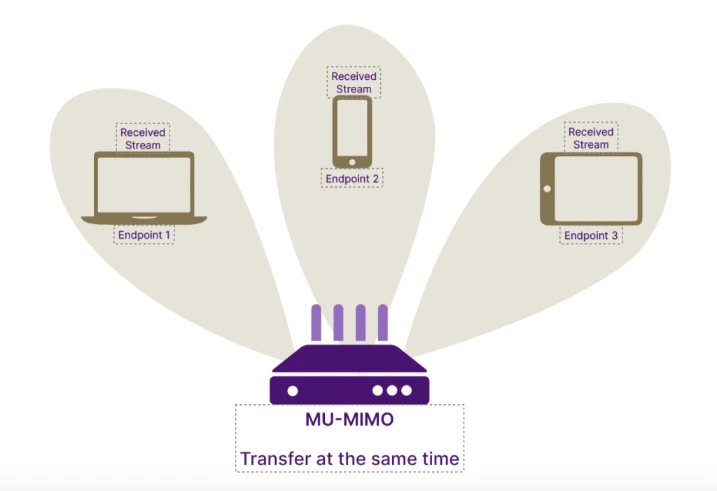
MU-MIMO technology was created for supporting environments where multiple users try to access the wireless network concurrently. Multi-User Multiple Input, Multiple Output (MU-MIMO) allows Access Points and their antennas to transmit data packets to multiple client devices simultaneously. MU-MIMO uses beamforming to direct signals towards wireless devices rather than uniformly spreading them in all directions. It allows an antenna to send radio signals from one location to multiple specific endpoints instead of transmitting around an entire area for stronger, better, and faster wireless communication.
In addition, MU-MIMO increases airtime efficiency so that every client gets the required amount of airtime based on the supported technology. With this technology, slower-speed clients no longer impede overall downlink throughput for other network users, ensuring a smoother experience for all.
This airtime efficiency becomes mission-critical in banking environments. A slow IoT sensor or a legacy ATM management terminal on WPA2 will no longer drag down throughput for the entire branch — MU-MIMO isolates each device's airtime allocation, preserving consistent performance for high-priority banking applications regardless of legacy device presence on the network.
Benefits of MU-MIMO
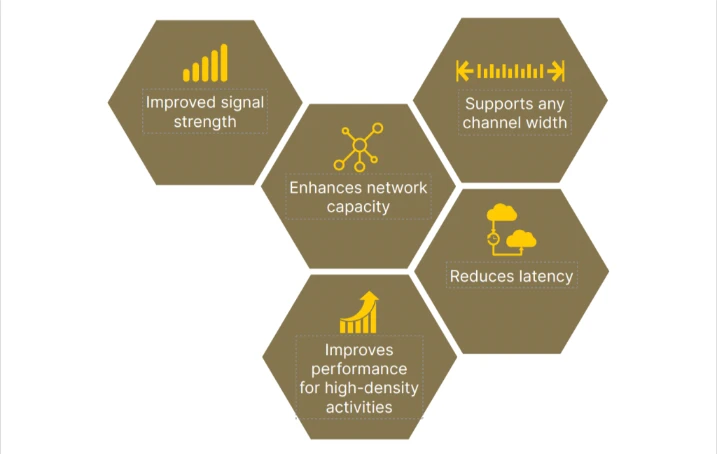
MU-MIMO offers several benefits to the modern Wi-Fi routers and devices including:
- Improved signal strength
- Enhances network capacity
- Supports any channel width
- Reduces latency
- Directs signals towards a wireless device using beamforming
- Eliminates the need for multiple antennas in user devices
- Improves video playback streams
- Improves performance for high-density activities — particularly in bank branches, hospital networks, and enterprise campuses where 20-30 wireless devices share a single AP
- Supports multi-VLAN environments by allocating separate spatial streams to isolated network segments (CBS, ATM, Guest Wi-Fi)
Where is MU-MIMO Best Suited?
MU-MIMO is best suited to bring-your-own-device (BYOD) scenarios where devices such as smartphones and tablets have a single antenna. Additionally, MU-MIMO is highly suitable for crowded areas where people are connecting all their devices to the same bandwidth.
In enterprise environments, MU-MIMO delivers its highest value in banking branch networks — where a single access point must simultaneously serve:
- Teller workstations running Core Banking Software (CBS)
- Relationship manager laptops handling loan applications and customer data
- Customer-facing kiosks and digital signage
- UPI/payment terminals requiring sub-10ms latency
- IP surveillance cameras on isolated VLANs
- Guest Wi-Fi for customers in the waiting zone
In this scenario, SU-MIMO would force all these devices into a single queue — causing CBS response delays and UPI transaction timeouts during peak hours. MU-MIMO eliminates this bottleneck by allocating dedicated spatial streams per device group, ensuring that a customer's KYC video call doesn't compete with a teller's real-time CBS query.
MU-MIMO vs MIMO
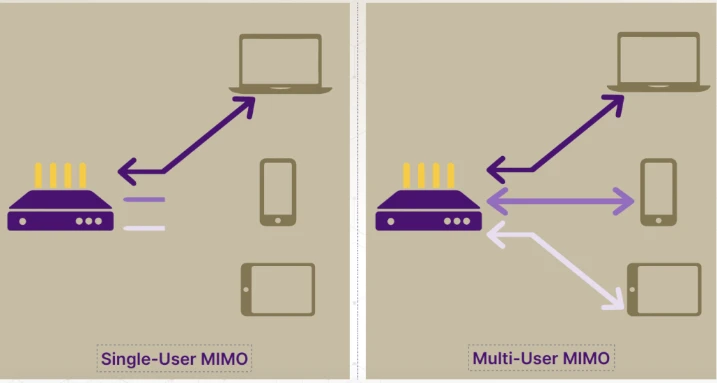
SU-MIMO (Single-User MIMO) or MIMO is the predecessor of MU-MIMO (Multi-User MIMO). The key difference between SU-MIMO and MU-MIMO is how many wireless devices can communicate with the Access Point at a particular instance of time. SU-MIMO lets a single wireless device communicate with the Access Point at a time. Meanwhile, MU-MIMO allows the Access Point to communicate with multiple devices simultaneously, easing the woes of devices battling for bandwidth.
MU-MIMO in RBI-Compliant Banking Networks
For Indian banks and NBFCs, MU-MIMO isn't just a performance feature — it's an architectural requirement. RBI's Cyber Security Framework mandates network separation between critical systems (SWIFT, RTGS, CBS) and general-purpose traffic. MU-MIMO-equipped Wi-Fi 6 access points, combined with dynamic VLAN segmentation and WPA3-Enterprise encryption, make this separation possible wirelessly — without needing separate physical SSIDs that create management overhead.
Wi-Fi 6's implementation of MU-MIMO supports up to 8 simultaneous spatial streams in both uplink and downlink — meaning a single IO by HFCL access point deployed in a bank branch can serve all device categories concurrently, at full speed, with zero airtime contention between security zones, — explore IO by HFCL's banking network solutions built on Wi-Fi 6 MU-MIMO for RBI-compliant deployments.
Closing Remarks on MU-MIMO: Redefining Wireless Connectivity for Tomorrow’s Demands
In summary, MU-MIMO has fundamentally transformed the landscape of wireless connectivity. Its capability to simultaneously serve multiple devices has revolutionized network efficiency and performance, ensuring a more equitable distribution of bandwidth. As we continue to witness its evolution alongside advancing Wi-Fi standards, MU-MIMO remains pivotal in meeting the ever-growing demands for faster and more reliable wireless connections. With its ability to mitigate congestion and accommodate diverse devices, MU-MIMO stands as a beacon of innovation, promising a future of enhanced and seamless wireless experiences for all users.






.svg)