

Subscribe to Our Updates
Join our community and be the first to receive exclusive insights
You are subscribed now!


.svg)

Products
Solutions
Resources
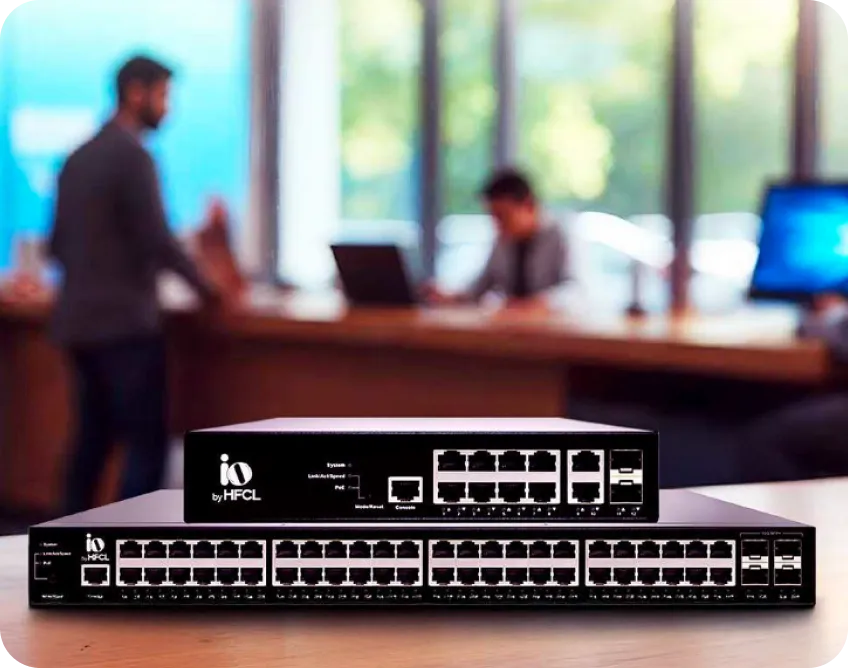
The Plus Series Network Switches deliver advanced Layer 3 intelligence, always-on reliability, and scalable performance for enterprises, campuses, and industrial environments.
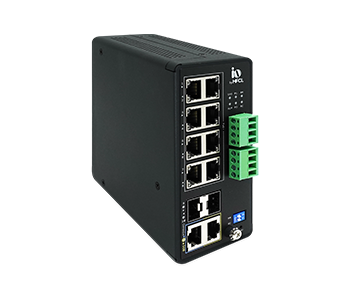
Available in 8-port, 24-port, and 48-port configurations—including rugged industrial-grade models—these managed Ethernet switches enable high-speed connectivity, advanced routing, and PoE+ power for IP phones, Wi-Fi access points, cameras, and IoT systems.
Static/OSPFv2/v3 for IPv4/IPv6, enabling advanced inter-VLAN routing and scalable enterprise/campus networks.
Redundant operations with dual PSUs, 10G uplinks, ensuring zero-downtime for BFSI/mission-critical sites.
-40°C to +75°C operation, DIN-rail mount, 240W+ PoE for harsh factories, surveillance, and IoT.




Switch deployments across 1,600+ branches deliver reliable Layer 2 connectivity and PoE for secure banking operations
Power enterprise networks with L2/L3 managed Ethernet switches: Performance, scalability, resilience from edge to core
Trusted across 1,600+ bank branches in India, the Plus Series delivers 802.1X authentication, dynamic VLAN segmentation, and Zero Touch Provisioning — purpose-built for RBI-compliant, Zero Trust branch deployments. From ATM zone edge switches to flagship branch distribution layers, it's the wired foundation India's leading banks rely on. Explore IO by HFCL's banking network solutions
WiFi 6 access points and managed switches upgrade rural infrastructure for enhanced efficiency
Deliver trusted, policy-controlled network access for banking environments with Plus Series switches — featuring dynamic VLAN segmentation that isolates teller systems, ATM backhaul, Core Banking traffic, and guest Wi-Fi on separate logical networks. dACL enforcement and 802.1X authentication ensure only authorised devices access critical financial systems, meeting RBI Cyber Security Framework requirements for network separation.
Choosing the right managed switch isn’t just about port count, it’s about scalability, intelligence, redundancy, and resiliency. The Plus Series managed switches cover every deployment need, from compact edge locations to high-density campus networks.
The 8-Port Plus Series delivers Layer 3 routing in a compact form factor — purpose-built for bank branch edge deployments, and rural Business Correspondent (BC) points where space is limited but security is non-negotiable. With per-port 802.1X authentication, 802.1Q VLAN isolation, PoE+ for Wi-Fi access points and IP surveillance cameras, and Zero Touch Provisioning for remote deployment without on-site IT staff, the 8-Port Plus brings enterprise-grade access-layer security to every edge point in a bank's branch network.
Industrial 8-port models add hardened temperature tolerance and DIN-rail mounting, making them perfect for factories, smart cities, outdoor sites and mission-critical environments.
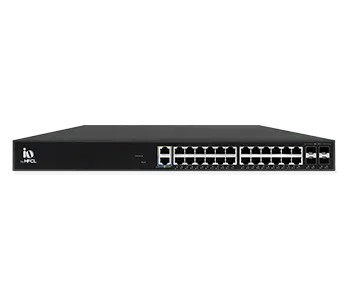
The 24-Port Plus Series is the access-layer switch for standard bank branches — connecting teller workstations, ATM terminals, Wi-Fi 6 access points, IP cameras, biometric readers, and video banking kiosks on a single managed unit. Dynamic VLAN assignment via 802.1X and RADIUS automatically places every device into its correct security zone — staff, ATM, payment, surveillance, or guest — eliminating misconfiguration risk across hundreds of branches, while 240W+ PoE and dual PSU support ensure always-on branch connectivity that meets RBI's mandate for network availability at banking sites.
The 48-Port Plus Series delivers enterprise-grade Layer 3 routing, high resiliency, and massive switching capacity for large-scale deployments. With advanced segmentation and robust PoE+, these switches reliably power hundreds of devices in mission-critical environments.
Common questions about advanced capabilities and scalability of Plus Series switches
All models in the C2+ and C3+ series have 4x1/10G SFP+ uplink ports. These ports are MSA compliant and offer the flexibility to terminate the connection on either copper or fiber-based SFP modules.
These are L3 Lite managed switches. They support basic Layer 3 features such as static routing, RIP v1/v2, and OSPFv2/v3 for both IPv4 and IPv6.
Yes, all models in the C2+ and C3+ series support IPv4/IPv6 dual stack and offer management features for both protocols.
These switches can be managed via CLI (Command Line Interface), WebGUI, Telnet, SSHv2, and SNMP v1/v2/v3.
Yes, they support up to 4094 VLAN IDs and various VLAN types including Voice VLAN, IP-subnet VLAN, Protocol VLAN, Private VLAN, and QiniQ.
Managed switches offer VLANs, dynamic segmentation, and Zero Trust policies that isolate users/devices and prevent unauthorized access. This is crucial for enterprises, campuses, and industrial networks handling sensitive data.
Always plan for 20–30% more ports than your current need. For example, if you have 18 wired devices, a 24-port managed switch ensures you won’t outgrow capacity as you add IP phones, APs, or IoT endpoints.